XML is rapidly becoming the way applications communicate. Because it isn't
one language but a means to create many languages, it can play many roles in
application integration and data exchange. In this article I'll explore some
of the varied roles that XML can play by developing a simple middleware
application that serves up data from a database.
The application (see Listing 1) uses XML in three ways: Requests from clients
are encoded in XML. Data sent back to a client is encoded in XML. The
database itself contains data marked up in XML. The application is written in
OmniMark - a 12-year-old language with a long history in the SGML community -
which became a free language in May 1999. It's based on the streaming
programming model pioneered by OmniMark and subsequently adopted by SGML and
XML translation languages like DSSSL and XSL. Streaming is also the principle ... (more)
This article demonstrates how to leverage XML, LDAP, and Java technologies to
create a Web-based directory lookup tool. This tool is built with a publicly
available implementation of a Java/XML publishing framework called Cocoon
(available at http://xml.apache.org/cocoon) and an LDAP server (we tested
with the iPlanet Directory Server on Solaris). Using these off-the-shelf
modules we can focus on the role of XML as a database-neutral format for
data, and how it enables a flexible application architecture that lets you
support both wireless and wireline clients. We'll demonstrate this with a WML
client (WAP phone simulator on Windows) and an SVG client (Adobe's SVG
plug-in for browsers on Windows).
This article assumes the reader has a fairly good knowledge of XML and a
working knowledge of XSL stylesheets. We'll first introduce WML (Wireless
Markup Language) and SV... (more)

Integrating mainframe applications into an SOA often carries the burden of
dealing with metadata in the form of Cobol Copybooks. This metadata converted
to an XML Schema format can be useful for a range of applications (from
validation to creation of services). This article explains how to automate
the conversion from Copybooks to XML Schema using regular expression logic.
Cobol Copybooks 101
Mainframe metadata is usually defined using a subset of the Cobol language.
Mainframe developers call these descriptions Copybooks. Cobol data definition
is based on a hierarchical structure composed by two different types of
items: Elementary Items and Group Items.
Elementary Item is the name Cobol assigns to a data item that is not further
subdivided (analogous to variables in other languages). Elementary Items are
composed of: a Level Number, a Data Name, and a Picture Clause.... (more)
This article shows how to build database Web applications using Oracle, two
open-source frameworks, and MetaBOX software. Building database Web
applications is commonly a repetitive task; many such applications are based
on insert/delete/update statements of tables in a form of simple rows,
multiple rows, or master/detail combinations.
To make this kind of application, many products offer different solutions -
we can divide them into procedural or declarative approaches. These products
provide wizards or code generators to help developers in the developing
stage.
Depending on which technologies these generators use - pure HTML or XML -
developers need to work more or less to get the desired output and maintain
their applications. The procedural approach requires developers to know what
they need and how to obtain it. Code generators for this approach generally
use... (more)
"What does the future hold for IT?" It's a burning question that everyone's
asking, but who can answer? At XML-Journal, we went straight to the experts -
the world's brightest and most prescient i-technology professionals - and
asked them what they expect in the coming year for IT in general and XML in
specific.
Industrys stakeholders - software vendors, developers, technology investors,
and users alike - are looking forward to the year ahead with renewed vigor.
The buzz is around XSL, Web services, and the service-oriented architecture.
The benefits of XML are clear...and in 2004 they'll become even clearer.
Following are some of the predictions we received from industry leaders...if
they are an indication of what's to come, it's going to be a great year.
Thom Robbins
Senior Technology Specialist
Microsoft
2004 is going to be the year of the service-oriented architect... (more)
I recently built a hands-on presentation for the FlexManiacs conference, and
thought it would be fun to have the class build a little apollo based mp3
player, which reads in the mp3 files from an iTunes libary.xml file, which
they can then play, paus
... (more)
Title: Re: Is "markup" a noun or a verb? Do you "marku
Well then, dal, I’d say if you already have those critters, you applied
markup to 132.
Verb. You selected the tag to mark up the string. That selection limits
the space of the transform, that is, the number of rules in which that tag
name may be found. Choice of choices or limits on the tree neighbors this
tag has by intension. Meaning is deliberate, not probabilistic.
Is a tag (the noun) semantically as rich as markup (the noun)?
len
From: Deborah Aleyne Lapeyre [mailto:[email protected]]
So where does the pre-defined schema, the contract, the design based on
sample or use cases fit in, Deb? --Len
All done long since. We know HOW to do it; we have our XML
vocabulary (supported by all the above and the ontology and the
use cases and the ...) in our hot little hands, and the only
question is wo... (more)
> ... should also be business as usual; interview, map data flows, > model
the data domain; abstract / normalize, validate the design with > the SME and
other users; iterate again until you have it close enough > for a prototype
then do the same thing all over again until your > prototype has grown up
into a real application. The fact that you're > using XML should not change
the way turn requirements into an logical > architecture. Should data be
designed for specific applications? Or, should data design be a matter of
documenting a cow path? I understand best when I see specific, concrete
examples, so let me provide one. Suppose I interview several Book SMEs. They
tell me that a Book is comprised of a Title, Author, Date, ISBN, and
Publisher. I document this data and the relationship (parent-child
relationship between Book and Title, Author, Date, ISBN, Publisher... (more)
A question came up on an internal mailing list regarding getting the
configuration off of the LTM into a format that can be parsed by an external
tool. In this case, the request was for an XML format of the BIG-IP
configuration. With iControl, It’s fairly simple to query configuration
objects and it’s just a matter of throwing in a few print statements to
build a XML document of the object hierarchy.
This article will show you how to query the list of LTM virtual servers and
their child properties and objects and then export the values into XML.
Initialization
I’ve implemented this sample in Perl, but it just as easily could have been
written in any language you prefer. The benefit of perl is that it can be
run from the command prompt on the BIG-IP itself.
the script starts with the normal perl declaration and variable
assignments. The input parameters are valida... (more)
Altera Corporation (NASDAQ:ALTR) today announced it is shipping volume
production of its 40-nm Stratix® IV GX EP4SGX230 FPGAs. The Stratix IV
device was the industry's first 40-nm FPGA available when it began shipping
at the end of 2008 and it continues to lead the market as the only 40-nm FPGA
in volume production. The Stratix IV family offers the highest density and
highest performance FPGAs available today, and is used in a variety of end
customer's high-speed backplane and cabling interfaces, chip-to-chip
interconnects and protocol-bridging applications.
Stratix IV GX FPGAs deliver an unprecedented combination of power,
performance and I/O bandwidth to designers manufacturing multi-gigabit
interconnected systems. The high-performance FPGAs feature Altera's latest
generation of proven transceiver technology. The 36 transceivers embedded in
the EP4SGX230 FPGA off... (more)
Connotate, a leading provider of solutions, which transform information from
the Web and enterprise into user-empowered on-demand applications and
actionable intelligence, today announced their inclusion in the "Innovative
Information Access Companies Under $100M to Watch" study published by IDC1.
The first study conducted by IDC of its kind, the nine companies selected by
IDC as innovative information access companies were chosen based on how well
they embodied one or more of three trends prevalent to information access
software. The trends focused on software requiring minimal training and
incorporating Web 2.0 capabilities; unified management of and access to
information; and intelligent process automation. Companies were recognized on
the final list based on their product adaptations and innovations addressing
the trends IDC identified.
“IDC recognized Connotate... (more)


 The precious oil is extracted from the seeds of prickly pear cactus plant. After taking out the seeds from the fruits, they are adequately dried and then cold pressed to obtain the oil. Indeed, the prickly seed oil is quite expensive. Well, that is understandable when you consider the fact that the seeds are really tiny and each seed contain only about 5% of oil in it at most, plus the seeds are usually handpicked from the fruits. This means it will take tons of these seeds to produce just one bottle of the oil for commercial purpose. But from its medical properties to its culinary importance, skin lightening, moisturizing, and protection abilities, down to its extraordinary hair care properties, prickly seed oil has got lots of excellent rewards for anyone who pays the price.
 The platform combines the strengths of Singtel's extensive, intelligent network capabilities with Microsoft's cloud expertise to create a unique solution that sets new standards for IoT applications," said Mr Diomedes Kastanis, Head of IoT at Singtel. "Our solution provides speed, transparency and flexibility, paving the way for a more pervasive use of IoT to accelerate enterprises' digitalisation efforts. AI-powered intelligent connectivity over Microsoft Azure will be the fastest connected path for IoT innovators to scale globally, and the smartest path to cross-device synergy in an instrumented, connected world.
 There are many examples of disruption in consumer space – Uber disrupting the cab industry, Airbnb disrupting the hospitality industry and so on; but have you wondered who is disrupting support and operations? AISERA helps make businesses and customers successful by offering consumer-like user experience for support and operations. We have built the world’s first AI-driven IT / HR / Cloud / Customer Support and Operations solution.
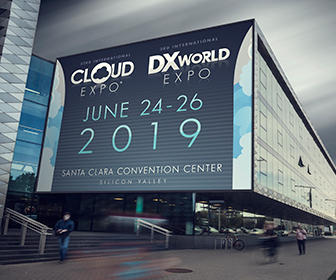
 ScaleMP is presenting at CloudEXPO 2019, held June 24-26 in Santa Clara, and we’d love to see you there. At the conference, we’ll demonstrate how ScaleMP is solving one of the most vexing challenges for cloud — memory cost and limit of scale — and how our innovative vSMP MemoryONE solution provides affordable larger server memory for the private and public cloud. Please visit us at Booth No. 519 to connect with our experts and learn more about vSMP MemoryONE and how it is already serving some of the world’s largest data centers. Click here to schedule a meeting with our experts and executives.
  Darktrace is the world's leading AI company for cyber security. Created by mathematicians from the University of Cambridge, Darktrace's Enterprise Immune System is the first non-consumer application of machine learning to work at scale, across all network types, from physical, virtualized, and cloud, through to IoT and industrial control systems. Installed as a self-configuring cyber defense platform, Darktrace continuously learns what is ‘normal' for all devices and users, updating its understanding as the environment changes.
 Subscribe to Industrial IoT Email News Alerts
 Subscribe via RSS


