 Digital technology innovations and advancements, and our adoption of them,
have changed us. We are different consumers, employers and employees. Our
expectations have increased. We have become mobile, impatient and demanding.
We are global. We demand immediate, accurate and real-time responses. We use
our technology not just for reading historic events and news, but also for
predicting our future turn while navigating at 60 MPH.
Today we want personalized and contextually relevant experiences. We want
digital experiences that are beautiful, simple and elegant. We want instant
access to all products, services, news, information and friends' status. We
want to share our lives instantly and globally. We want to find things, buy
things, move money and complete transactions from anywhere at anytime. We
want to work from anywhere and have all the information we need instan... (more)
Digital technology innovations and advancements, and our adoption of them,
have changed us. We are different consumers, employers and employees. Our
expectations have increased. We have become mobile, impatient and demanding.
We are global. We demand immediate, accurate and real-time responses. We use
our technology not just for reading historic events and news, but also for
predicting our future turn while navigating at 60 MPH.
Today we want personalized and contextually relevant experiences. We want
digital experiences that are beautiful, simple and elegant. We want instant
access to all products, services, news, information and friends' status. We
want to share our lives instantly and globally. We want to find things, buy
things, move money and complete transactions from anywhere at anytime. We
want to work from anywhere and have all the information we need instan... (more)

The size of competitors and the longevity of their brands, are less
predictive of future success than the quality and speed of their information
logistics systems, and their ability to use it as a competitive advantage.
More data is being generated today than ever before, and successful companies
are investing in business analytics and big data solutions to mine
competitive advantages. There is a new sense of urgency today as businesses
realize data has a shelf life, and the value of it diminishes rapidly over
time. In an always-connected world where consumers and their needs ar... (more)

Technologies help us deliver on a business strategy. Without a strategy,
there is no rationale for deploying technologies. In addition, there is no
rationale for digital transformation, unless there is a need for business
transformation. If you believe this as we do, then strategy development
will be a priority. Strategies, however, are developed under the guidance
of a doctrine. The purpose of a doctrine is to create a high level
understanding of what we we want to achieve with our strategy, and the
concepts that must be employed to achieve it. An organization's doctrine w... (more)

A key challenge that retailers face today is the difficulty of accurately
judging where they are on the digital maturity curve relative to their
competitors. There appears to be little expertise in making this assessment;
for example, 79% of digital leaders don't know they are ranked as leaders,
and only 56% of retailers ranked as average in our study believe they are at
this level. The other 44% in the average category mistakenly believe they are
either leaders or laggards. The lack of competitive clarity makes it even
more difficult to develop an effective competitive strategy.... (more)

Digital leaders think differently about the role and value of digital
technologies, including the ability of these tools to enable competitive
advantage in the form of revenue growth, and positively impact work and jobs.
As a result, leaders are developing more aggressive technology plans and
strategies than digital laggards.
The military strategist Colonel John Boyd wrote that success depends on three
things, 1) People, 2) Ideas, and 3) Things, in that order. People have to
be trained to think and do the right things, using the right ideas
(doctrines, strategies and tactics) a... (more)


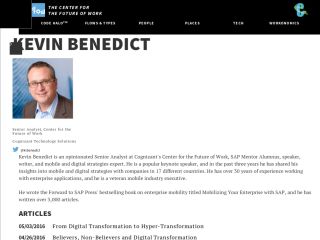
 Kevin Benedict is an opinionated Senior Analyst at Cognizant's Center for the Future of Work, SAP Mentor Alumnus, speaker, writer, and mobile and digital strategies expert. He is a popular keynote speaker, and in the past three years he has shared his insights into mobile and digital strategies with companies in 17 different countries. He has over 30 years of experience working with enterprise applications, and he is a veteran mobile industry executive.
He wrote the Forward to SAP Press' bestselling book on enterprise mobility titled Mobilizing Your Enterprise with SAP, and he has written over 3,000 articles.
Kevin Benedict is an opinionated Senior Analyst at Cognizant's Center for the Future of Work, SAP Mentor Alumnus, speaker, writer, and mobile and digital strategies expert. He is a popular keynote speaker, and in the past three years he has shared his insights into mobile and digital strategies with companies in 17 different countries. He has over 30 years of experience working with enterprise applications, and he is a veteran mobile industry executive.
He wrote the Forward to SAP Press' bestselling book on enterprise mobility titled Mobilizing Your Enterprise with SAP, and he has written over 3,000 articles.
 Michel Courtoy
 Amitabh Sinha
 Mark Leake
 Rajeev Kozhikkattuthodi
 Stefana Muller
 Jordan Shamir
 Tracy Bannon
 Lev Lesokhin
 Nishanth Kadiyala
 Arvind Radhakrishnen


